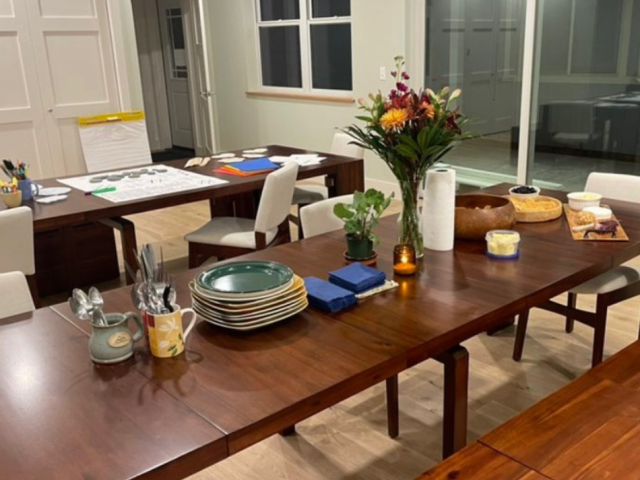
Support groups

Building Futures Free from Violence

When Stacy (name changed for privacy) first moved to the Methow Valley ten years ago, she was looking for stability both for herself and for her kids.

When Stacy (name changed for privacy) first moved to the Methow Valley ten years ago, she was looking for stability both for herself and for her kids. She learned about Room One’s parenting group from a flyer in the post office and worked up the courage to show up one evening, hoping to find resources and maybe a few friendly faces. What she found was a community that saw her, listened to her, and helped her begin to believe in her own strength and abilities again.

A few years later, Room One launched a different support group for women who had lived with domestic violence and instability, and Stacy was one of the first to sign up. There, she found language for experiences she’d spent years trying to make sense of — the slow erosion of confidence, the control disguised as care, the fear that kept her small. Sitting in a circle with other women, she learned that she wasn’t alone.

Now, Stacy talks about what it’s like to see her own children growing up in a place where empowerment and connection are nurtured from the start.

“I think about how different things might have been if I’d had something like this group as a teenager…If someone had told me back then that I didn’t have to earn love by being quiet and submissive, maybe I would’ve made different choices.”

That “maybe” is what fuels our prevention work. At Room One, we believe that the path to ending violence begins long before it happens — by creating spaces where people learn what respect and self-worth look like in action.

Our youth programs are rooted in the same values that guide our support groups: dignity, self-determination, and the unwavering belief that everyone deserves safety. In these programs, young people learn to see themselves as worthy of love and belonging, and that they themselves have the ability to create meaningful change in their lives and communities. They talk about healthy decision-making and boundary setting. They discover that asking for help is a strength, not a weakness.

Stacy’s story is one of healing, but it’s also a glimpse of the future we’re working toward: a future where cycles of harm are interrupted so early, and communities are so well-resourced and connected, that adult survivor groups are no longer needed. Every conversation with a young person, every skill built around empathy and communication, is an act of prevention and a step toward a world where healing groups like Stacy’s are replaced by generations who never have to recover from violence in the first place.